Picture a first-year veterinary student in your large-animal teaching barn. It’s her third week of clinical rotations. She’s confident and focused, but… maybe a little too relaxed about the PPE protocol because the procedure looks routine. Then a wound irrigation splashes. Fluids on her forearm. No gown.
Was that wound infected with MRSA? Salmonella? Tetanus?
That scenario plays out somewhere every semester — because students aren’t yet calibrated to the invisible hazard density of veterinary work. 31.5% of veterinary students report contracting at least one zoonotic infection during their clinical education.
That’s why there’s a renewed focus on proper barrier PPE for the veterinary industry, especially at the education level. From getting the right garments (rated to ASTM F1671 viral penetration standards) to teaching a written donning and doffing sequence your students can execute under pressure, and making PPE choices that match the specific hazard — whether that’s a biofluid splash during a large-animal procedure, a chemical spill, or secondary contamination from an X-ray suite.
Veterinary health and safety compliance isn’t a single checklist; it’s a set of overlapping standards from OSHA, the CDC, and the AVMA that your curriculum either addresses or doesn’t. This guide breaks it all down by clinical hazard category, so you can teach it that way too.
Why zoonotic exposure is the baseline risk in every vet setting
According to the CDC’s National Institute for Occupational Safety and Health, some 60% of the more than 1,400 known human pathogens are zoonotic. About 75% of emerging pathogens are zoonotic. Veterinarians, vet techs, and veterinary assistants aren’t an abstract population at risk — they’re the professionals with the most consistent, hands-on exposure to the animals carrying those pathogens.
Transmission happens through several routes: direct contact with blood, urine, saliva, fecal matter, or tissue from infected animals; inhalation of aerosolized particles during procedures; and dermal contact with contaminated surfaces, tools, or equipment. For students and new clinicians, the risk is compounded by inexperience. High contact frequency plus developing technique equals a higher-than-average window for exposure.
The good news is that surgical-grade barrier PPE addresses most of these routes directly. The condition is that it has to be the right gear, worn correctly, and removed without contaminating the wearer on the way out.
What OSHA actually requires from veterinary employers and educators
OSHA’s obligations for veterinary practices are specific and documented. Here’s what the standard requires:
- Written job hazard assessments: Employers — including veterinary schools — must conduct and document a workplace-specific hazard evaluation to determine what PPE each role needs. This isn’t optional, and it isn’t generic; the assessment must reflect the actual tasks performed in your facility.
- Bloodborne pathogen exposure control plans: OSHA’s bloodborne pathogen standard applies to veterinary workers with exposure to animal blood and body fluids. The plan must include universal precautions, access to Hepatitis B vaccination, PPE provision (gloves, face shields, impermeable gowns), and post-exposure protocols.
- Ongoing training with records: Initial training isn’t enough. OSHA requires continual training as procedures change, and records documenting each employee’s name, training type, and date must be maintained.
- Radiation safety: For practices using X-ray equipment, OSHA’s radiation safety standards require lead gloves and other PPE, caution signage, dosimetry badges, and written operation instructions.
- Chemical hazard management: Veterinary staff face exposure to disinfectants, hazardous drugs, latex, pesticides, and waste anesthetic gases. Chemical hazard plans must address all the hazards directly.
The AVMA’s PPE guidance offers a strong complement to OSHA’s regulatory floor. Where OSHA defines the minimum, the AVMA helps translate those requirements into clinical practice. Both are worth building into your safety curriculum as primary references.
Biological hazards: the case for impermeable barrier PPE
ASTM F1671 is the gold standard test for resistance to viral penetration under continuous liquid contact. A garment that passes this test has been subjected to viral surrogates at pressure and has not allowed penetration. For veterinary use, where blood, urine, and tissue fluids are routine exposure vectors, this standard is the relevant benchmark.
Not all PPE sold for clinical use meets it. Gowns labeled “fluid resistant” and garments rated to lesser standards offer meaningfully different protection from garments that have passed F1671 testing. When you’re selecting PPE for a teaching clinic, that distinction is worth making explicit to students — because they’ll be making procurement decisions of their own within a few years.
Building a complete veterinary PPE kit
A full barrier PPE kit for high-exposure veterinary procedures includes:
- Jumpsuit or coverall — full-body coverage for surgeries, necropsies, and large-animal procedures where splash exposure is unpredictable
- Knee-high or bootleg leggings — essential when floor contamination is likely, particularly in large-animal settings; non-skid versions add traction on wet surfaces
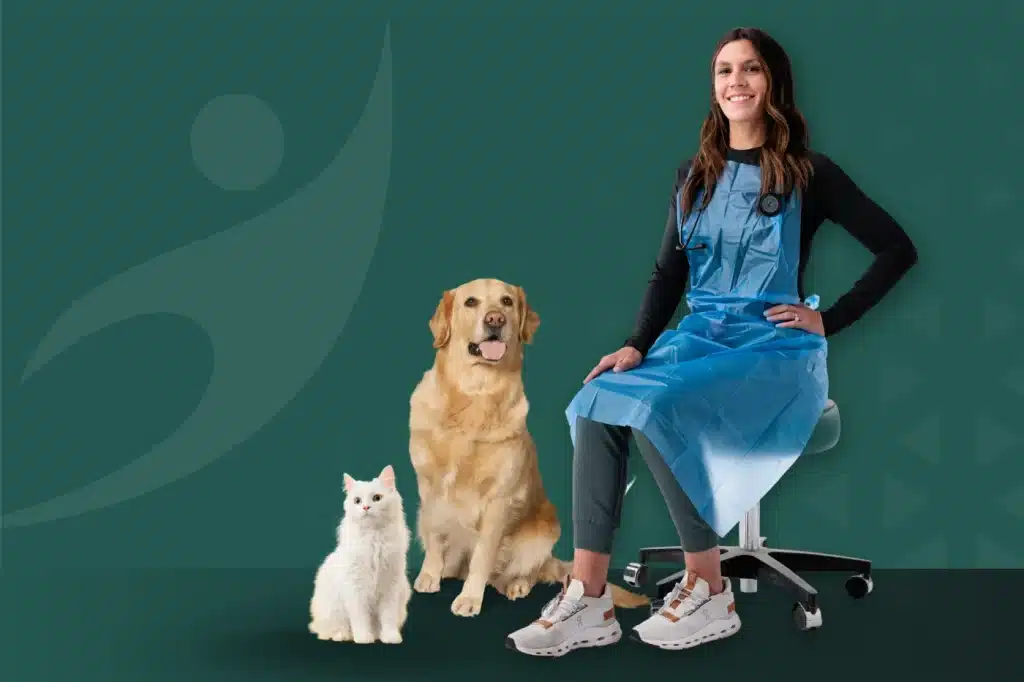
- Impermeable apron — a secondary fluid layer for work at a table; lighter than a full jumpsuit for lower-risk tasks
- Shoe covers — the most commonly skipped item, and one of the most important for preventing facility-wide cross-contamination
- Disposable gloves — nitrile preferred for chemical resistance; always the last item donned
- Face shield or goggles — required for any procedure with aerosol or splash risk
- Surgical mask or respirator — procedure-dependent; N95 for suspected aerosolized pathogen exposure
Disposable garments have a specific advantage in teaching environments: they eliminate the laundering variable. A reusable gown that was improperly washed, stored contaminated, or worn without inspection is a liability. Single-use gear arrives sterile, performs consistently, and gets disposed of at the point of doffing — no ambiguity.
For a deeper look at how these garments layer in surgical settings, see our guide to disposable surgical PPE clothing and how to build a protective system.
Beyond microbes: when veterinary hazards have teeth (and hooves, and claws…)
Obviously, not every injury in a veterinary setting comes from a microbe. A frightened dog in pain bites before they realize it. A 1,200-pound horse doesn’t intend harm but may certainly cause it. Cats bite and scratch with enough force to break skin in ways that create both physical injury and immediate infection exposure pathways. And for large-animal practitioners, teachers, and students, the physics of the work — restraint, positioning, manual procedures — add blunt-force and crush risks that no PPE garment was designed to prevent on its own.
That’s why vet safety education needs to treat physical hazard assessment as its own category, not a footnote to the infection chapter. Preventing animal bites and scratches in veterinary practice relies on recognizing behavioral stress signals, using low-stress handling techniques, applying appropriate physical or chemical restraint, and ensuring continuous staff training.
Preventing crush and blunt-force injury in large animal veterinary practice is about facility design and equipment controls, low-stress handling methods, practitioner positioning and body awareness, and chemical restraint. Vets and handlers must never wedge their bodies between a large animal and an unyielding surface. Teach students how to inspect and maintain squeeze chutes, head gates, and alleyways to ensure smooth, non-jerky operation.
Radiation exposure is a further consideration. Any teaching clinic running diagnostic imaging needs a radiation safety protocol that includes lead aprons, lead gloves, and thyroid shields for staff in the room during exposures. OSHA’s radiation standards also require dosimetry badges so cumulative exposure can be tracked. Students rotating through radiology need to understand this gear as a non-negotiable — not as optional equipment used by cautious people.
Naturally, like all medical professionals, veterinary staff and students handle a wide array of chemical hazards: disinfectants, concentrated cleaning agents, hazardous chemotherapy drugs in oncology settings, pesticides, and waste anesthetic gases. Chemical-specific PPE typically means impermeable gloves rated for the substance, splash goggles, and in some cases a face shield or respirator. An impermeable apron is often appropriate here too. The general rule is that a garment rated for biological fluid exposure will also protect against most chemical splashes — but always verify compatibility for specific substances.
Teaching students to identify the hazard first, then select the gear, is more durable than giving them a checklist. The AVMA’s guidelines reinforce this framework, and it maps cleanly onto the hazard assessment methodology OSHA already requires.
Teaching don/doff as clinical protocol, not a formality
Learning what to wear, and when, is one skill. Learning how to take it all off without contaminating yourself and your surroundings is another matter entirely.
Donning is straightforward — you put on clean gear before you’re exposed. Doffing requires removing contaminated gear without touching the contaminated surfaces with bare skin, and doing it in the right sequence so you don’t transfer contamination to yourself or the environment as you go. Studies on healthcare worker self-contamination have consistently found that doffing is where the exposure happens, not donning.
The standard sequence for donning PPE:
- Hand hygiene
- Gown or jumpsuit
- Mask or respirator
- Shoe covers or knee-highs
- Face shield or goggles
- Gloves (last — should overlap the gown’s cuffs)
Doffing PPE reverses the contamination risk, outside-in:
- Remove gloves (peel away, turning inside out, dispose)
- Hand hygiene
- Remove gown or jumpsuit (touching only the inside, roll away from body)
- Hand hygiene again
- Remove face shield or goggles (handle by headband, not the front surface)
- Remove mask or respirator (handle by straps, not the front)
- Final hand hygiene
A designated doffing area with a waste container positioned before the exit is the physical infrastructure that makes this work. Without it, the procedure breaks down even when students know the sequence.
One practical advantage of one-size-fits-all disposable PPE in a teaching clinic: you’re not managing fit variations across a cohort of 20 students. Everyone uses the same SKU, everyone dons and doffs the same way, and the demonstration translates directly to practice.
For a full visual walkthrough of the donning and doffing sequence, the CDC NIOSH module on PPE donning and doffing and our own step-by-step PPE guide are both useful teaching references.
See how STA-DRI holds up in clinical conditions. We’ll send a free sample pack to your department — no commitment, no purchasing conversation required until you’re ready. Request your free sample here.
Building PPE into the vet school curriculum
Most veterinary educators we’ve worked with don’t skimp on the safety training. They are trying to figure out where it fits, without consuming clinical time that’s already stretched thin.
The answer is to treat PPE protocol as a clinical skill with a competency framework, not as a compliance module. When donning and doffing are assessed the same way suture technique is assessed — observed, corrected, repeated — students internalize the sequence rather than just tolerating it.
A practical veterinary PPE teaching framework that maps directly onto OSHA’s requirements:
- Identify the hazard (what biological, chemical, physical, or radiation risks does this procedure involve?)
- Select the appropriate PPE (match the garment to the hazard; understand what each item is rated for)
- Don in the correct sequence (demonstrate, have students mirror, correct errors immediately)
- Perform the procedure (PPE stays on; reinforce what correct coverage looks like mid-procedure)
- Doff in the correct sequence (timed, observed, with a waste container staged correctly)
- Document (satisfies OSHA’s training record requirement and builds the habit for professional practice)
Disposable PPE makes this teachable without the overhead of a laundry protocol. Students practice with real gear that behaves exactly as it will on a clinical day.
STA-DRI garments — tested to ASTM F1671 and available in a full product line from jumpsuit to knee-high shoe cover to apron — give faculty a consistent kit to teach from. Our single SKU per product system (one-size-fits-all) means your supply room doesn’t require separate size inventory for a class of 30.
Preparing veterinary students for a healthier future in animal care
When students leave your program, they’ll be making decisions about their own PPE, their staff’s PPE, and in some cases the protocols for an entire clinic. What they see modeled during their training is what they’ll default to under pressure.
We want to make it easy for you to teach and provide the best possible PPE to your students. Try our products in your clinic, free! We ship free sample products directly to department purchasing contacts, clinical lab coordinators, professors, students, or faculty.
Frequently asked questions
OSHA requires veterinary employers to complete a written job hazard assessment identifying PPE needs for each role, maintain a Bloodborne Pathogen Exposure Control Plan, and provide staff with appropriate PPE including gloves, face shields, and impermeable gowns or aprons. Training with documented records is mandatory, and the standard must be updated as procedures change. For radiation-specific requirements, OSHA also mandates lead PPE, dosimetry monitoring, and written safety procedures.Get more information in the Merck Veterinary Manual.
The primary biohazardous substances in veterinary clinics are blood, urine, saliva, fecal matter, and tissue from animals — all of which can carry zoonotic pathogens transmissible to humans. Anesthetic gases, hazardous drugs used in oncology treatment, disinfectants, and pesticides constitute the chemical hazard side of the equation. Barrier PPE rated to ASTM F1671 directly addresses fluid-based biological exposure; chemical-specific gloves and splash eyewear are required for chemical hazards.
Donning follows a head-to-floor sequence: mask or respirator, then gown or jumpsuit, shoe covers, face shield or goggles, and finally gloves — which should overlap the gown’s cuffs. Doffing reverses the sequence outside-in, with hand hygiene performed after removing gloves, after removing the gown, and again after removing all remaining items. Doffing is where most self-contamination actually happens, so it needs to be taught as a timed, observed clinical skill — not just described in a slide deck. At Sloan Medical, we’ve seen the best compliance results when don/doff practice uses the same disposable gear students will use on rotation, so the physical sequence is familiar before the first clinical day. For a full reference, visit our step-by-step PPE guide.
About Sloan Medical
Sloan Medical is a leading North American manufacturer of premium surgical PPE (STA-DRI) and patient transfer sheets (ezGLIDE®), designed by surgeons for optimal safety and performance. A Midwest-based, family-owned company founded by urologist Dr. Stewart Sloan, Sloan Medical has been producing impermeable, ASTM-tested disposable PPE since 1989 — all handcrafted in North America, with most products shipping within 24 hours. Learn more at sloanmedical.com/about/.